Computing began as a way to hold numbers still while a person did the thinking, and it has become a way to learn patterns from data without being told the rules. This guide follows that shift step by step: from the abacus to mechanical calculators, electronic computers, the transistor, the microprocessor, the internet and today's AI chips.
It is written by a software team in Kathmandu, and it ends with what the history means for anyone learning to code or running a business in Nepal today.
The short version
- Counting aids (thousands of years ago): the abacus stores the numbers; a person supplies the method.
- Mechanical machines (1600s to 1800s): gears do the arithmetic, and punched cards start to carry instructions.
- Electronic computers (1940s): switches with no moving parts make calculation thousands of times faster.
- Transistors and chips (1947 onward): computers shrink from rooms to desks to pockets.
- Networks and phones (1990s to 2000s): the computer becomes a connection to everything else.
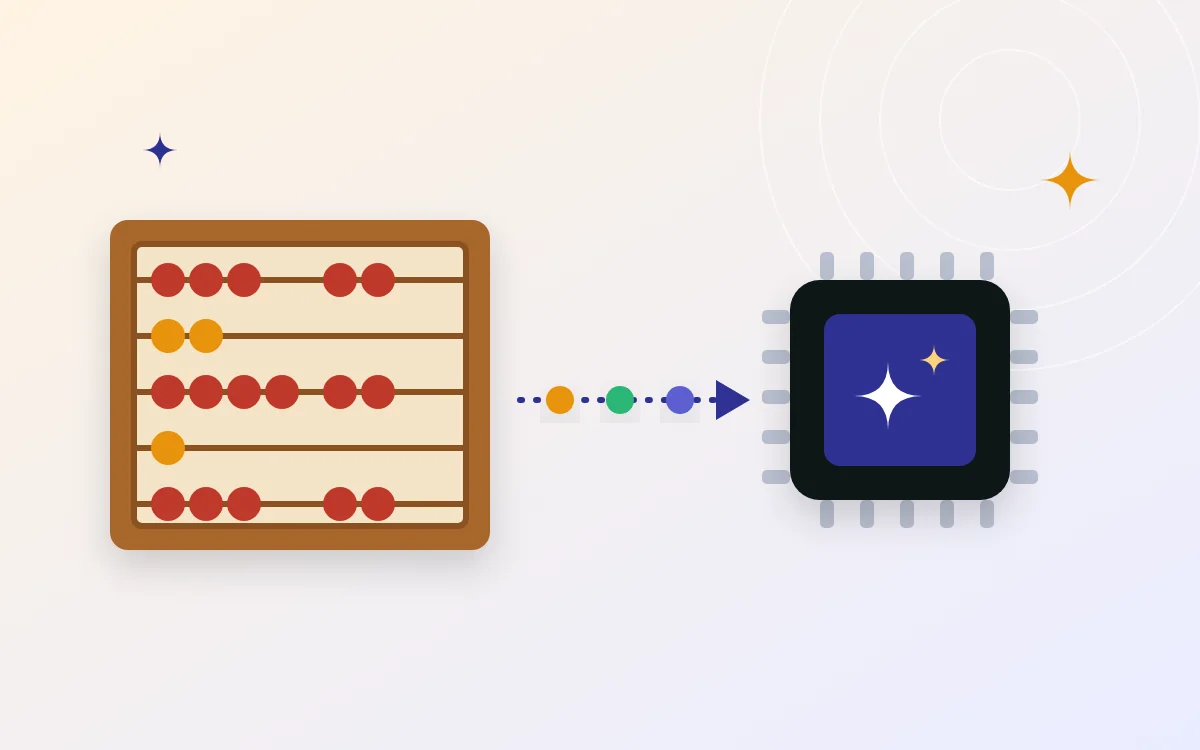
- AI chips (2010s onward): machines learn from data, using processors built for huge amounts of parallel work.
The abacus: memory you can touch
The abacus is one of the oldest calculating aids. Sumerian counting boards from about 2700 to 2300 BC used columns to mark place values, and the Chinese suanpan is documented in writing from the 2nd century BC. The Japanese soroban was brought over from China in the 14th century.
What matters is how it works. The beads store the state of a calculation, and the person supplies the method. A skilled user can add and subtract very quickly, because the tool removes the need to remember digits, not the need to think. Every later machine in this story takes over a little more of the method as well as the memory.
Gears and punched cards: machines that follow steps
In 1642 Blaise Pascal built a gear-driven adding machine, and Gottfried Leibniz later designed one that could also multiply. In 1804 Joseph Marie Jacquard's loom used punched cards to control the pattern woven into cloth, so the same loom could weave different designs just by changing the cards. That is an early, widely used example of a machine whose behaviour is set by a changeable program.
In the 1830s Charles Babbage designed the Analytical Engine, a general-purpose mechanical computer that was never finished in his lifetime. Ada Lovelace's 1843 notes on it described how such a machine could be programmed. In 1890 Herman Hollerith's punched-card tabulators were used to process the US census, showing that machines could handle data at the scale of a nation.
Vacuum tubes: the first electronic computers
In 1936 Alan Turing's paper on computable numbers set out what a general-purpose computing machine can do in principle. In the 1940s the theory met the hardware. ENIAC, designed by John Mauchly and J. Presper Eckert for the US Army and announced to the public in February 1946, used about 18,000 vacuum tubes, weighed more than 30 tons and could perform around 5,000 additions or subtractions per second.
That was far faster than a person with a mechanical calculator, but it filled a room and its fragile tubes were a constant limit. The ideas were right; the components held them back.
The transistor and the chip: shrinking the machine
In 1947 John Bardeen, Walter Brattain and William Shockley at Bell Labs created the first working transistor, a solid-state switch that does the job of a vacuum tube without the heat, size or fragility. In the late 1950s Jack Kilby and Robert Noyce developed the integrated circuit, which put several transistors on a single piece of material, and the idea of packing more and more of them onto one chip took off.
In 1965 Gordon Moore observed that the number of components on a chip was doubling at a steady pace, and the observation became known as Moore's law. On 15 November 1971 Intel released the 4004, the first commercial microprocessor: a complete processor on one chip, with about 2,300 transistors. It was a tiny fraction of the power of a modern chip, but it started the road to the personal computer.
The same year in Nepal
The year Intel released the 4004 is also the year Nepal's first computer arrived. For the 1971 census, the government used a rented IBM 1401, a second-generation mainframe that read punched cards, to process the results. It was the first time a computer had been used for census processing in Nepal. Accounts of the details differ, so we point to the UNDP's story of Nepal's first computer for the background.
Personal computers, the web and the phone
Through the 1970s and 1980s the microprocessor turned computers into products people could own. In 1989 Tim Berners-Lee proposed the system that became the World Wide Web, and the web turned connected computers into something anyone could browse. In 2006 Amazon Web Services began renting computing power to anyone, which let a small team use the same kind of infrastructure as a large company. In 2007 Apple released the first iPhone, and apps became the main way many people use software.
For a developer in Nepal, the last two changes mattered most: you can reach customers anywhere through the web, and you can rent servers instead of buying them.
From calculating to learning: why AI changed the shape of computing
For most of this history, computers did what programmers told them, step by step. Deep learning reversed that. Instead of writing the rules, engineers train a model on a large amount of data and let it find the patterns. That needs enormous numbers of simple multiplications done at the same time, which is exactly what graphics processors (GPUs) were built for.
In 2012 a neural network called AlexNet, trained on GPUs, won the ImageNet image-recognition contest by a wide margin and showed what the combination could do. In 2017 researchers at Google introduced the Transformer design behind today's large language models, and in November 2022 ChatGPT brought the result to the public.
Today's AI chips are descendants of the 4004: billions of transistors in a single package instead of thousands. We explain how they are made in how Nvidia's AI chips are made.
What stayed the same
- Abstraction wins. Each step hid the layer below it. You do not need to know how a transistor works to write a program, or how a GPU works to call an AI model.
- Tools replace effort, not judgement. The abacus did not decide what to add. A modern AI model still needs a person to decide what is worth building and whether the answer is right.
- Hardware and software move together. New hardware makes room for new software, and demand for software pays for the next hardware.
What it means in Nepal today
You do not need your own chip factory to benefit from this history. Cloud providers rent out processors, including GPUs, by the hour, and AI models are available through simple APIs, so a small team can build useful software on top of them. The skills that matter most are the durable ones: thinking clearly about the problem, using good data, testing, and maintaining what you ship.
If you are starting out, read our guide to becoming a software engineer in Nepal and the AI engineering skills and roadmap. If you run a business and want to know where AI fits, see adding AI to business software in Nepal.
Next steps
If you want to build something with these tools, tell us what you are trying to solve and we will suggest a practical way to start.
Sources and further reading
- Wikipedia: Abacus
- Wikipedia: ENIAC
- Wikipedia: Transistor
- Wikipedia: Intel 4004
- UNDP Nepal: Nepal's first computer
- Computer History Museum: computerhistory.org
Have a project in mind?
Tell us what you're trying to solve. Or keep reading: SEO for AI Search: What Google Says Still Works.