A good software testing strategy tests the riskiest behaviour first, automates the fast and repeatable checks, keeps a small number of end-to-end tests for critical journeys, and leaves exploratory and security testing to people. The aim is not to test everything but to find the failures that would hurt your users and your business before they do.
This guide is for developers, QA engineers and managers who want a practical plan. It reflects how a delivery team in Kathmandu tests client projects, and it complements our guides on becoming a software engineer in Nepal and outsourcing software development.
What a testing strategy is
A strategy answers four questions: what will we test, at which level, how much will be automated, and who is responsible. It is different from a test plan for a single release. Write it once, keep it short and revise it when the product or team changes.
The test pyramid
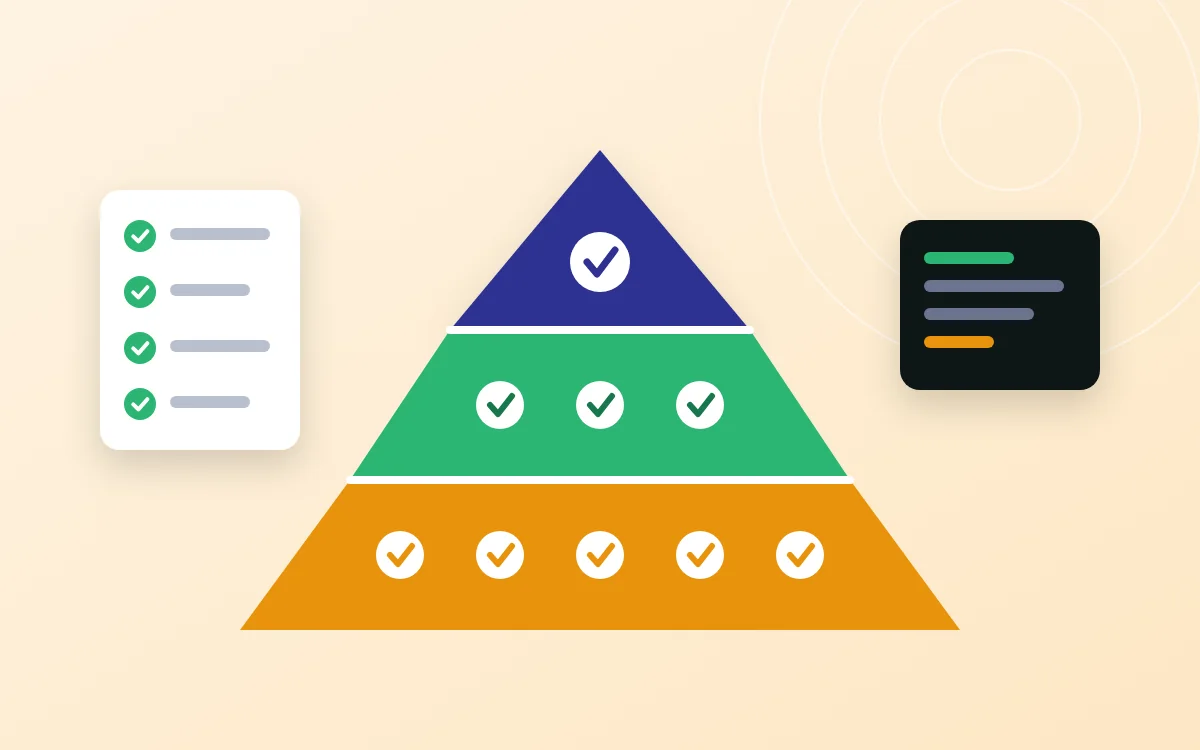
Most teams think in layers. The widely used practical test pyramid describes many fast, cheap tests at the bottom and a few slow, expensive ones at the top.
- Unit tests: check one function or class in isolation. They run in milliseconds, so you can have thousands. They are the foundation.
- Integration tests: check that parts work together, such as your code with the database or an external API. Fewer, and slower.
- End-to-end (UI) tests: drive the real application like a user. They give the most confidence per test but are slow and can be fragile, so keep them for critical journeys such as sign-up, checkout or invoicing.
If your pyramid is upside down, with mostly slow UI tests and few unit tests, expect long build times and flaky results.
Types of testing and when they matter
- Functional testing: does the feature do what the requirement says.
- Regression testing: did a change break something that used to work. This is where automation pays off most.
- Exploratory testing: a skilled person explores the product without a script and finds what scripts miss. Do not automate this away.
- Performance testing: how the system behaves under load, before launch rather than after.
- Security testing: looks for weaknesses such as injection and broken access control. The OWASP Web Security Testing Guide is the standard reference.
- Usability and accessibility testing: can real people complete their tasks, including people using assistive technology.
- Compatibility testing: browsers, screen sizes and phone models your users actually have. In Nepal that means testing on mid-range Android devices and slower connections, not only on a fast laptop.
A simple strategy for a small team
- List the critical journeys. The five things that must never break: for a billing product, creating an invoice, recording a payment, and exporting a report.
- Write unit tests for business rules. Tax calculations, discounts and permissions are where bugs cost money.
- Add integration tests around the database and external services. Payment gateways and SMS providers should be tested against their sandbox environments.
- Automate one end-to-end test per critical journey. Tools such as Playwright make this practical.
- Run everything automatically on every change. Tests nobody runs are decoration. Put them in your CI pipeline, a practice we cover in our DevOps and security work.
- Reserve human time for exploratory, usability and security testing before each release.
Deciding what to test first
Rank features by risk: how likely they are to break multiplied by how much damage a failure causes. A rarely used settings page can wait; the code that calculates a customer's bill cannot. Revisit the ranking after every serious bug, because production failures show where your assumptions were wrong.
Handling bugs
- Reproduce first and write a failing test that captures the bug, then fix it. The test stops it coming back.
- Record severity and impact, not just a description, so the team fixes what matters first.
- Look for the cause in the process: a missing requirement, a missing test, a rushed review.
What to measure
Useful measures are few: how many bugs escape to production, how long a build takes, how many tests are flaky, and how long a bug takes to fix. Code-coverage percentage alone is easy to game and does not tell you whether the important behaviour is tested.
Mistakes to avoid
- Testing only at the end of a project, when changes are most expensive.
- Relying on one person to click through the app before each release.
- Automating UI tests for everything, then spending more time fixing tests than features.
- Ignoring flaky tests until nobody trusts the suite.
- Treating testers as a separate team that receives finished work, instead of part of planning.
Careers and certification
Testing is a respected specialty. The ISTQB offers recognised certifications that some employers ask for, and strong engineers combine testing skill with automation and a solid understanding of the product. If you are building skills, our courses and careers page are good places to start.
Need help?
If your team ships bugs it should have caught, or you want QA built into an outsourced project, contact Kodedristi and we will review your approach.
Sources and further reading
- Martin Fowler: The Practical Test Pyramid
- OWASP: Web Security Testing Guide
- Playwright: playwright.dev
- ISTQB: istqb.org
Have a project in mind?
Tell us what you're trying to solve. Or keep reading: How to Become a Software Engineer in Nepal.